

Stress Management Training for First Responders Under Pressure

Emergency responders do not get to choose when pressure arrives.
A law enforcement officer may have seconds to assess a rapidly changing situation. A firefighter may need to make decisions while exposed to heat, noise, and uncertainty. A paramedic may be working to stabilize a patient while managing multiple demands at once. A dispatcher may need to communicate clearly while receiving incomplete or emotionally charged information.
In these moments, technical knowledge matters. Training, policy, communication, and experience all count. But knowing what to do is only part of the challenge.
The ability to regulate stress and maintain performance under pressure also matters.
That is where Stress Management Training and performance training can become an important part of professional preparation for first responders.

What happens to performance under stress
Acute stress is the body’s rapid response to a perceived threat or demanding situation. It prepares the body to act by changing heart rate, breathing, muscle tension, attention, and hormone activity.
These changes can help in the right amount. Increased alertness can sharpen focus. A faster response can help someone move quickly. Narrowed attention can make an immediate threat easier to track.
But when stress becomes too intense, performance can start to suffer.
A responder may experience:
Faster, shallower breathing
Tunnel vision or reduced situational awareness
Difficulty processing new information
Rushed communication
Loss of fine motor control
Over-fixation on one task
Trouble recalling procedures
Slower or more rigid decision-making
Research in policing, military, emergency medicine, and high-risk occupations suggests that stress can affect perception, judgment, motor skills, and communication. This does not mean responders are weak or unprepared. It means the human nervous system has limits.
Performance Under Pressure depends on how well a person can work within those limits.
The goal is not to eliminate stress. That is not realistic in emergency work. The goal is to build the ability to recognize stress, regulate it, and keep doing the next right thing.
Why technical training is not enough by itself
First responders spend many hours learning protocols, equipment, tactics, medical procedures, defensive skills, radio communication, and scene safety. This foundation is essential
But a skill learned in a calm classroom may feel very different in a chaotic scene.
A paramedic can know a protocol well, yet still struggle when working in a cramped space with noise, family members nearby, and a patient declining fast. A firefighter can know the correct sequence, yet still need to manage fear, heat, limited visibility, and physical fatigue. An officer can understand de-escalation, yet still face a rapidly changing encounter with incomplete information.
Performance Training helps close the gap between knowledge and use.
The question is not only, “Can the responder do the skill?”
The better question is, “Can the responder do the skill while stressed, tired, distracted, and under time pressure?”
Effective First Responder Training should account for both the technical task and the stress state of the person performing it.
Stress and performance follow a curve
Stress and Performance are connected, but not in a simple way.
Too little activation can lead to low urgency, slow response, or reduced focus. A moderate level of activation can improve alertness and energy. Too much activation can create overload.
This is often described as an inverted curve. Performance improves as stress rises to a useful level, then drops when stress becomes excessive.
That pattern can show up in many ways:
Stress level | Possible effect on performance |
Low | Reduced urgency, distraction, low engagement |
Moderate | Better focus, alertness, readiness to act |
High | Narrowed attention, rushed choices, impaired communication |
Extreme | Freezing, panic, confusion, task failure |
The exact point where performance starts to decline varies by person, skill, experience, sleep, health, training, and the scene itself.
A veteran firefighter may stay organized in a high-heat event that overwhelms a recruit. A newer dispatcher may struggle during a high-volume incident that a more experienced dispatcher can manage. A paramedic may perform well on a familiar call type but feel overloaded by an unusual pediatric emergency.
Training can help responders raise their capacity. It can also help them notice when they are nearing overload.

What useful stress management training teaches
Stress management for emergency responders should be practical. It should not feel like a generic wellness lecture pasted onto a high-risk profession.
The best training connects body awareness, decision-making, and real job demands.
Recognize the stress response early
A responder cannot regulate what they do not notice.
Early signs may include jaw tension, clenched hands, quick breathing, narrowed vision, rushed speech, or an urge to move before thinking. These signs are not failures. They are information.
A useful training program teaches responders to identify their own stress cues before they become overwhelming.
That awareness creates a small but valuable window. In that window, a responder can pause, breathe, communicate, slow a decision, or ask for support.
Use breathing to control physiology
Tactical Breathing is one of the most common tools taught in high-pressure performance settings. It is simple, portable, and does not require equipment.
One common version uses a steady pattern:
Inhale through the nose for a count of four
Hold for a count of four
Exhale for a count of four
Hold for a count of four
Repeat for several cycles
The count can vary. The principle matters more than the exact number. Slower, controlled breathing can help reduce over-arousal and bring attention back to the task.
This is not magic. It will not make danger disappear. But it can help a responder regain enough control to think, speak, and act more clearly.
Build decision-making under pressure
High-pressure scenes rarely provide perfect information. Responders often need to act while uncertainty remains.
Training can prepare them by using scenarios that include:
Time limits
Competing demands
Noise and distractions
Incomplete information
Role players
Physical exertion
Communication challenges
Changing conditions
The goal is not to create chaos for its own sake. The goal is to teach responders how to process pressure while still following sound decision-making principles.
Good scenario training includes a debrief. The debrief should examine what happened, what the responder noticed, what options were available, and how stress affected choices.
Practice recovery after activation
Emergency work often involves repeated activation. A responder may go from calm to intense action, then back to waiting, then into another demanding call.
Recovery is part of performance.
Training should teach responders how to come down after a high-stress event. This may include controlled breathing, a brief reset routine, peer check-ins, hydration, movement, or after-action review. The point is to prevent stress from stacking unchecked across a shift, a week, or a career.
This content is informational only and does not replace medical or mental health care. Responders experiencing ongoing distress, trauma symptoms, or thoughts of self-harm should seek qualified support immediately.
Training should match real operational pressure
A major mistake in stress training is making it too abstract:
First responders do not operate in perfect conditions. Training should reflect the environments they actually face, while still protecting safety and learning quality.
For law enforcement, that may include rapidly changing threat assessment, communication under uncertainty, use-of-force decision-making, and post-incident regulation.
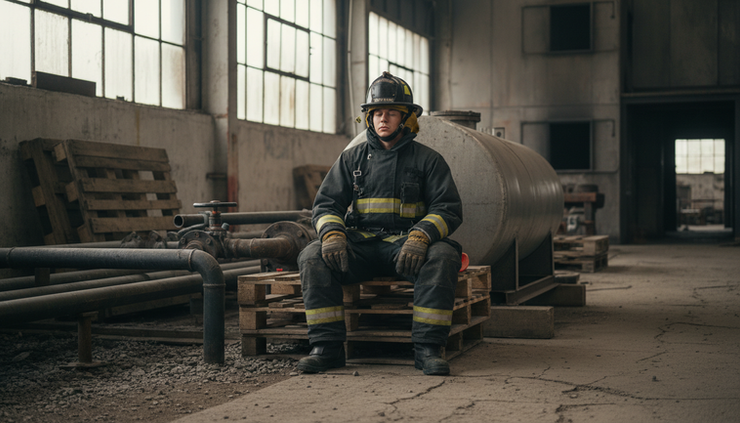
For firefighters, it may include heat, gear, low visibility, air management, crew communication, and command structure.
For EMS, it may include patient decline, bystander pressure, tight spaces, multiple patients, and fast handoffs.
For dispatchers, it may include emotionally charged callers, incomplete information, radio traffic, and sustained concentration. Because dispatch work often takes place outside the physical scene, stress training should still include realistic audio, competing priorities, and reset skills between calls.
Resilience is built through repeated, supported practice
Resilience Training for First Responders is sometimes misunderstood as simply becoming tougher. That view is too limited.
Real resilience is the ability to prepare, perform, recover, learn, and return to readiness.
It is built through repetition and support.
A strong program may include:
Education on the stress response
Controlled exposure to realistic pressure
Breathing and grounding skills
Scenario-based decision practice
After-action review
Peer support habits
Sleep, recovery, and fitness education
Leadership support for healthy performance standards
The best results come when these elements work together. A breathing skill practiced once in a classroom may be forgotten during a real call. A scenario without debriefing may build stress but not learning. A wellness message without operational relevance may be ignored.
Training should be repeated, realistic, and tied to the mission.
What leaders can do to support performance under pressure
Stress performance is not only an individual responsibility. Culture and leadership play a major role.
Leaders can support responders by making regulation skills normal, practical, and expected
That starts with language. If stress regulation is framed as weakness, people may hide overload until it affects performance. If it is framed as a professional skill, people are more likely to practice it.
Leaders can also build better training conditions.
Useful steps include:
Include stress regulation in regular skills training
Add short breathing resets before and after scenarios
Make debriefs focused on learning rather than blame
Train supervisors to recognize overload signs
Encourage peer check-ins after difficult calls
Protect recovery time when operationally possible
Avoid using stress exposure as punishment
The goal is not to lower standards. The goal is to help people meet high standards under real pressure.
What responders can practice on their own
Formal training matters, but small habits also help. A few minutes of practice outside a call can make regulation tools easier to access during a call.
Responders can practice:
Controlled breathing during routine moments
Use a breathing pattern while parked, before shift, after a call, or while preparing equipment. The skill becomes more useful when it is familiar.
Body scanning
Notice tension in the jaw, hands, shoulders, and breathing. Relax what can be relaxed. This builds awareness of early stress cues.
Mental rehearsal
Picture a difficult but realistic scenario. Rehearse the first few actions, the communication, and the reset. Keep it grounded in policy and training.
Post-call reset
After a demanding event, take a brief pause when possible. Breathe, label what happened, check equipment, rehydrate, and reconnect with the team.
After-action reflection
Ask three simple questions.
What went well?
What got difficult?
What should be practiced next?
These habits do not replace formal instruction. They help keep performance skills active between training sessions.

The goal is calm enough to act well
Emergency responders will always face pressure. No training can remove uncertainty, danger, grief, conflict, or urgency from the work.
But training can change how pressure is handled.
Stress management and performance training help responders recognize their own physiological response, regulate breathing, maintain attention, and make better decisions when conditions are difficult. These skills are professional skills. They belong next to tactics, medicine, communication, fitness, and policy.
The aim is not perfect calm. The aim is being calm enough to act well.
A responder who can pause for one breath, widen their attention, communicate clearly, and choose the next right action has a better chance of performing when it matters most.


Comments